
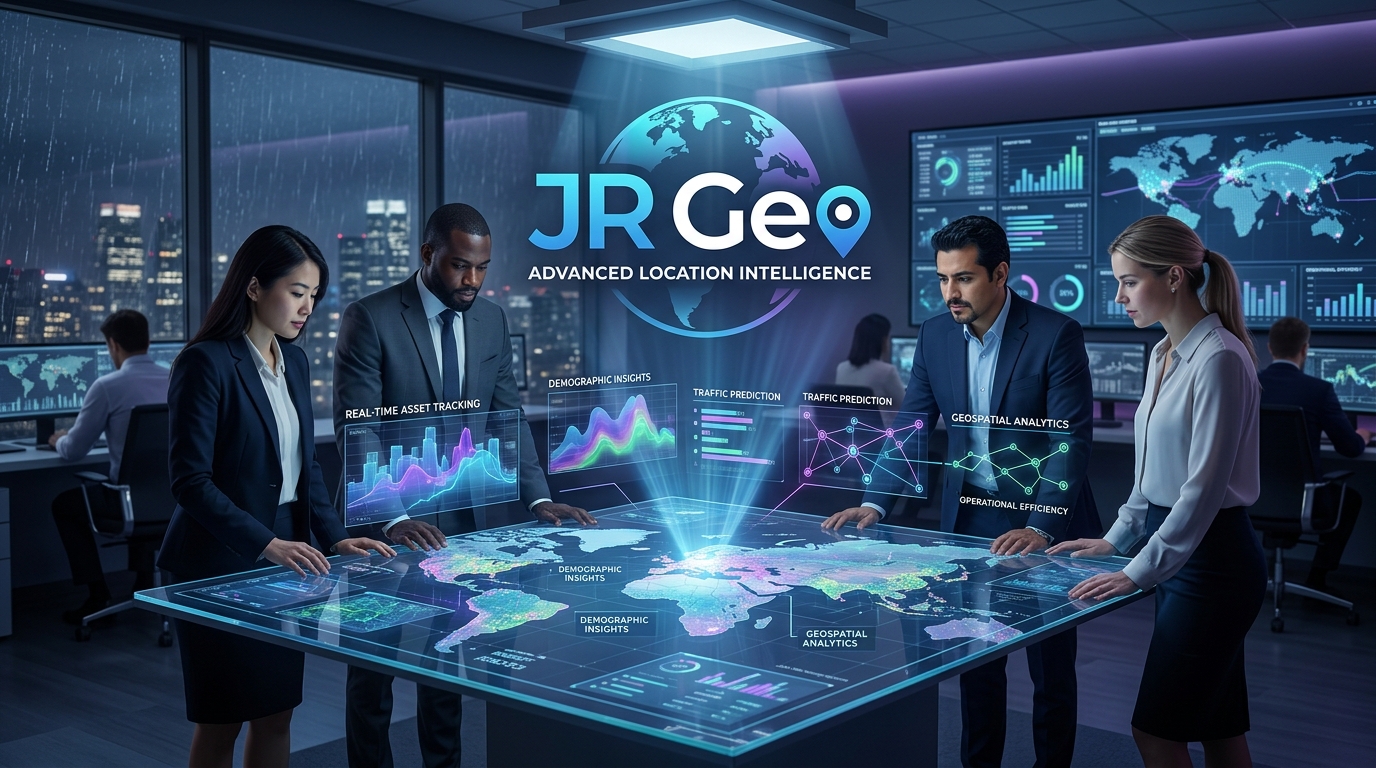
Transforming the Way Businesses Understand Place and Space
Every modern business decision carries a geographic dimension that most organizations still overlook entirely. Where customers live, where infrastructure breaks down, where competitors cluster, and where opportunities emerge — all of these questions have spatial answers. JR Geo Solutions tackles these questions head-on by delivering advanced location intelligence that transforms raw geographic data into powerful, actionable business insights. Furthermore, this company brings together cutting-edge geospatial technology, deep analytical expertise, and practical industry knowledge under one unified platform. Consequently, organizations across multiple sectors gain a genuine competitive advantage by understanding not just what is happening, but precisely where it is happening and why location matters so fundamentally.
What Is Location Intelligence and Why Does It Matter
Defining Location Intelligence in the Modern Context
Location intelligence refers to the process of deriving meaningful insights from data that contains a geographic or spatial component. Businesses generate enormous volumes of location-tagged data every single day through transactions, logistics, customer interactions, and operational activities. Therefore, organizations that extract intelligence from this spatial data make smarter decisions faster than competitors who ignore geography entirely.
Moreover, location intelligence goes far beyond simply placing points on a digital map for visual reference. It involves spatial analysis, pattern recognition, predictive modeling, and the integration of multiple geographic datasets simultaneously. As a result, decision-makers gain a multi-dimensional understanding of their operational environment that purely numerical data simply cannot provide.
Furthermore, the rapid growth of GPS-enabled devices, satellite imagery, and IoT sensors has created an unprecedented flood of location data. Organizations now collect more spatial data than ever before, yet many struggle to convert that raw data into genuine intelligence. Consequently, specialized companies that help bridge this gap between data collection and actionable insight have become enormously valuable across industries.
The Business Case for Spatial Analysis
Companies that integrate location intelligence into their core decision-making processes consistently outperform those that do not. Retail businesses use spatial analysis to identify optimal store locations, understand customer catchment areas, and analyze competitor proximity effectively. Therefore, every major expansion or consolidation decision benefits directly from rigorous geographic analysis and evidence-based spatial reasoning.
Additionally, logistics companies use location intelligence to optimize delivery routes, reduce fuel consumption, and improve on-time delivery performance. Supply chain managers use spatial data to identify vulnerable infrastructure points, alternative routing options, and strategic warehouse placement opportunities. Consequently, the financial impact of sophisticated location analysis across logistics operations alone can reach tens of millions of dollars annually.
Moreover, government agencies and urban planners rely on spatial intelligence to allocate public resources, plan infrastructure projects, and respond to emergencies effectively. Healthcare organizations use geographic analysis to identify underserved populations, plan facility locations, and track disease spread patterns. As a result, location intelligence has become a foundational capability rather than an optional enhancement across virtually every sector.
The JR Geo Solutions Approach to Geospatial Intelligence
Core Philosophy and Methodology
JR Geo Solutions builds its entire service offering around a clear and powerful philosophy: location context makes every dataset more valuable and every decision more intelligent. The company combines rigorous spatial science with practical business consulting to ensure that clients receive insights they can actually use. Therefore, every project begins with a deep understanding of the client’s specific business challenge rather than a generic technical solution.
Furthermore, the company’s methodology integrates multiple data sources, analytical techniques, and visualization approaches to create comprehensive spatial intelligence products. Analysts combine satellite imagery, demographic data, infrastructure records, and real-time sensor feeds into unified analytical frameworks. Consequently, clients receive a complete and nuanced picture of their geographic operating environment rather than fragmented data snapshots.
Additionally, JR Geo Solutions emphasizes the importance of making complex spatial analysis accessible to non-technical business users throughout the organization. Beautiful, intuitive dashboards and interactive maps translate sophisticated analytical outputs into formats that any executive or field manager can understand. As a result, location intelligence becomes embedded throughout organizational decision-making rather than confined to technical specialist teams.
Technology Infrastructure and Platform Capabilities
The company builds its analytical capabilities on a robust and modern technology infrastructure that handles massive spatial datasets efficiently. Cloud-native architecture allows the platform to scale dynamically with client data volumes and processing requirements without performance degradation. Therefore, organizations with enormous datasets receive the same responsive and reliable analytical experience as smaller clients with more modest requirements.
Moreover, JR Geo Solutions integrates with leading GIS platforms including industry-standard tools that geospatial professionals already use in their daily workflows. This integration capability means clients do not need to abandon existing investments in spatial software or retrain entire technical teams. Furthermore, open API architecture allows the platform to connect with ERP systems, CRM platforms, and business intelligence tools clients already rely upon.
Additionally, machine learning capabilities embedded within the platform allow it to identify spatial patterns that human analysts might miss in complex multi-layered datasets. Predictive models learn from historical spatial data and generate forward-looking intelligence about future geographic trends and developments. Consequently, clients gain both retrospective understanding of past geographic patterns and predictive foresight about emerging spatial opportunities or risks.
Key Service Areas and Industry Applications
Urban Planning and Smart City Development
JR Geo Solutions delivers sophisticated spatial intelligence tools specifically designed for urban planning professionals and smart city initiatives. City planners use the platform to model population growth scenarios, infrastructure capacity requirements, and land use optimization opportunities simultaneously. Therefore, municipal governments make evidence-based planning decisions rather than relying on outdated assumptions or incomplete spatial information.
Furthermore, the company’s smart city solutions integrate data from traffic sensors, utility networks, public transit systems, and environmental monitors into unified spatial dashboards. City managers gain real-time visibility into urban system performance across multiple interconnected infrastructure domains. As a result, they identify emerging problems earlier, allocate maintenance resources more efficiently, and improve overall quality of life for urban residents meaningfully.
Moreover, the platform supports community engagement processes by creating accessible visual tools that help residents understand proposed urban changes and provide informed feedback. Interactive maps and scenario visualization tools make complex planning proposals comprehensible to non-specialist community members. Consequently, public participation in urban planning processes becomes more substantive, more geographically informed, and more productive for all stakeholders involved.
Environmental Monitoring and Natural Resource Management
Environmental organizations and natural resource managers use JR Geo Solutions to monitor landscape changes, track ecosystem health, and support conservation planning efforts. Satellite imagery analysis tools detect deforestation, land degradation, wetland loss, and coastal erosion with remarkable precision and temporal consistency. Therefore, environmental managers respond to threats earlier and allocate conservation resources to the highest-priority geographic areas.
Additionally, the platform supports environmental impact assessment processes by providing detailed baseline spatial data and change detection capabilities. Engineers and environmental consultants use these tools to document pre-project conditions, model potential impacts, and monitor actual outcomes over time. Furthermore, regulatory compliance reporting becomes more rigorous, more defensible, and more efficient when spatial data underpins the entire assessment process.
Moreover, agricultural applications of the platform help farmers and agribusinesses understand soil variability, optimize irrigation, and maximize crop yield across geographically diverse landholdings. Precision agriculture guided by spatial intelligence reduces input costs, improves environmental outcomes, and increases overall farm profitability simultaneously. Consequently, the agricultural sector represents one of the fastest-growing application areas for advanced location intelligence tools globally.
Infrastructure and Utilities Management
Utility companies and infrastructure operators face extraordinarily complex spatial challenges that JR Geo Solutions addresses with specialized analytical tools. Electricity grid operators use spatial analysis to identify vulnerable infrastructure segments, optimize maintenance scheduling, and plan network expansion projects strategically. Therefore, they reduce outage frequency, shorten restoration times, and extend asset lifespans through geographically informed maintenance practices.
Furthermore, water and wastewater utilities use the platform to manage pipe network condition, model hydraulic performance, and prioritize capital replacement investments across aging infrastructure systems. Spatial risk modeling helps utilities identify which pipe segments pose the greatest failure risk based on age, material, soil conditions, and operational pressure. As a result, limited capital budgets achieve maximum risk reduction through geographically targeted investment strategies.
Additionally, telecommunications companies use location intelligence to plan network coverage, identify coverage gaps, and optimize antenna placement for maximum signal quality. Site selection for new infrastructure requires careful spatial analysis of terrain, population density, interference patterns, and regulatory constraints simultaneously. Consequently, spatial intelligence tools dramatically reduce the time and cost associated with network planning and regulatory approval processes.
Retail and Real Estate Analytics
Retail businesses and real estate developers rely heavily on location intelligence to make high-stakes investment decisions with greater confidence and precision. Site selection analysis combines demographic profiling, competitor mapping, traffic flow analysis, and accessibility modeling into comprehensive location scoring frameworks. Therefore, retailers minimize the risk of costly site selection mistakes that can undermine years of business development effort.
Moreover, trade area analysis tools help retailers understand the true geographic extent of their customer catchment areas based on actual transaction data. They identify underperforming locations where catchment area competition or demographic shifts are eroding sales performance. Furthermore, they discover underserved geographic markets where demand exists but supply remains insufficient to meet it effectively.
Additionally, real estate developers use spatial analysis to identify emerging neighborhood trends before they become widely recognized and property values fully reflect them. Transportation infrastructure changes, demographic shifts, and commercial development patterns all create geographic investment signals that spatial analysis reveals earlier. As a result, spatially sophisticated developers consistently identify value-creation opportunities ahead of less analytically rigorous competitors in the market.
Data Integration and Management Capabilities
Handling Diverse Spatial Data Sources
One of the most significant technical challenges in location intelligence involves integrating spatial data from numerous different sources, formats, and coordinate systems. JR Geo Solutions has built robust data ingestion pipelines that handle this complexity automatically without requiring extensive manual data preparation. Therefore, analysts spend their time generating insights rather than wrestling with technical data compatibility challenges.
Furthermore, the platform ingests satellite and aerial imagery, LiDAR point clouds, GPS track data, demographic surveys, administrative boundaries, and real-time sensor streams simultaneously. Each data source contributes a different analytical layer to the overall spatial intelligence picture. Consequently, the combined analytical power of multiple integrated datasets far exceeds what any single data source could deliver independently.
Moreover, the company maintains extensive proprietary data libraries covering demographic profiles, infrastructure networks, land use classifications, and environmental indicators across numerous geographic markets. Clients access these curated datasets immediately without needing to source, purchase, and prepare them independently. As a result, projects launch faster, cost less, and benefit from data quality standards that individual organizations rarely achieve on their own.
Real-Time Data Processing and Dynamic Intelligence
Modern business environments require spatial intelligence that updates continuously rather than reflecting conditions from weeks or months ago. JR Geo Solutions has invested heavily in real-time data processing infrastructure that delivers dynamic location intelligence at operational speeds. Therefore, field teams, logistics managers, and emergency responders access spatial insights that reflect current rather than historical conditions.
Furthermore, streaming data integration allows the platform to incorporate live feeds from IoT sensors, connected vehicles, weather stations, and social media location signals. These real-time inputs combine with static spatial datasets to create a continuously updated operational picture. Additionally, automated alert systems notify relevant stakeholders when spatial conditions cross predefined thresholds requiring immediate attention or intervention.
Consequently, organizations move from purely retrospective spatial analysis toward genuinely predictive and real-time operational intelligence. This shift from historical reporting to dynamic operational awareness represents a fundamental advancement in how organizations use geographic information. As a result, location intelligence becomes woven into moment-to-moment operational decision-making rather than informing only long-range strategic planning exercises.
Building Internal Spatial Capability Through Training and Support
Knowledge Transfer and Team Development
JR Geo Solutions recognizes that sustainable client value requires building internal spatial analytical capability rather than creating permanent consulting dependency. The company invests substantially in training programs, workshops, and knowledge transfer initiatives that develop client team competencies. Therefore, organizations gradually internalize spatial thinking and analytical skills that enhance their long-term decision-making independence.
Furthermore, the company offers structured learning pathways covering GIS fundamentals, spatial data management, analytical methodology, and platform-specific technical skills. These programs accommodate varying levels of prior spatial knowledge from complete beginners to experienced GIS professionals seeking advanced specialization. Consequently, entire organizations can develop a culture of spatial thinking rather than concentrating expertise within a single specialist team.
Moreover, ongoing technical support, user communities, and regular platform training updates ensure that clients continue growing their capabilities as the technology evolves. Dedicated customer success managers maintain close relationships with client organizations and proactively identify opportunities for deeper capability development. As a result, clients consistently extract greater value from their platform investment as their internal spatial intelligence maturity grows over time.
The Future Direction of Location Intelligence
Emerging Technologies Shaping the Field
The location intelligence field is evolving rapidly as artificial intelligence, edge computing, and advanced sensor technologies converge with traditional geospatial science. AI-powered spatial analysis tools will increasingly automate routine analytical tasks and focus human expertise on higher-value interpretive and strategic work. Therefore, organizations that invest in location intelligence capabilities today position themselves advantageously for a technology environment that will only become more spatially sophisticated.
Furthermore, the proliferation of autonomous vehicles, drone delivery systems, and smart infrastructure will generate volumes of location data that dwarf anything currently available to analysts. Organizations that develop the analytical frameworks to process and interpret this coming data tsunami will gain extraordinary competitive advantages. Consequently, building spatial analytical capability today represents a strategic investment in future organizational competitiveness rather than simply solving current operational challenges.
JR Geo Solutions’ Vision for the Next Decade
The company actively invests in next-generation capabilities including AI-enhanced spatial pattern recognition, augmented reality field visualization tools, and quantum computing applications for complex spatial optimization problems. These investments ensure the platform remains at the absolute frontier of location intelligence capability as the technology landscape evolves. Therefore, clients who partner with JR Geo Solutions today gain access to a continuously advancing platform rather than a static product frozen in time.
Moreover, the company is expanding its geographic coverage, industry vertical expertise, and data library depth to serve an increasingly global and diverse client base. Strategic partnerships with satellite operators, sensor network providers, and academic research institutions strengthen the company’s data and analytical foundations continuously. As a result, JR Geo Solutions reinforces its position as a genuine leader in delivering advanced location intelligence to organizations worldwide.
Conclusion
Location intelligence has moved from a specialized technical capability to a genuine strategic necessity for organizations operating in complex, fast-changing environments. JR Geo Solutions stands at the center of this transformation by delivering powerful, accessible, and continuously evolving spatial intelligence tools and expertise. Furthermore, the company’s commitment to client capability development, technological innovation, and practical business impact sets it apart from purely technical competitors in the market. Therefore, organizations that partner with this company do not simply gain access to mapping software — they gain a powerful analytical lens that fundamentally sharpens every geographic dimension of their decision-making. Consequently, the path toward smarter, faster, and more spatially aware organizational decisions runs directly through the kind of advanced location intelligence that JR Geo Solutions delivers every day.