
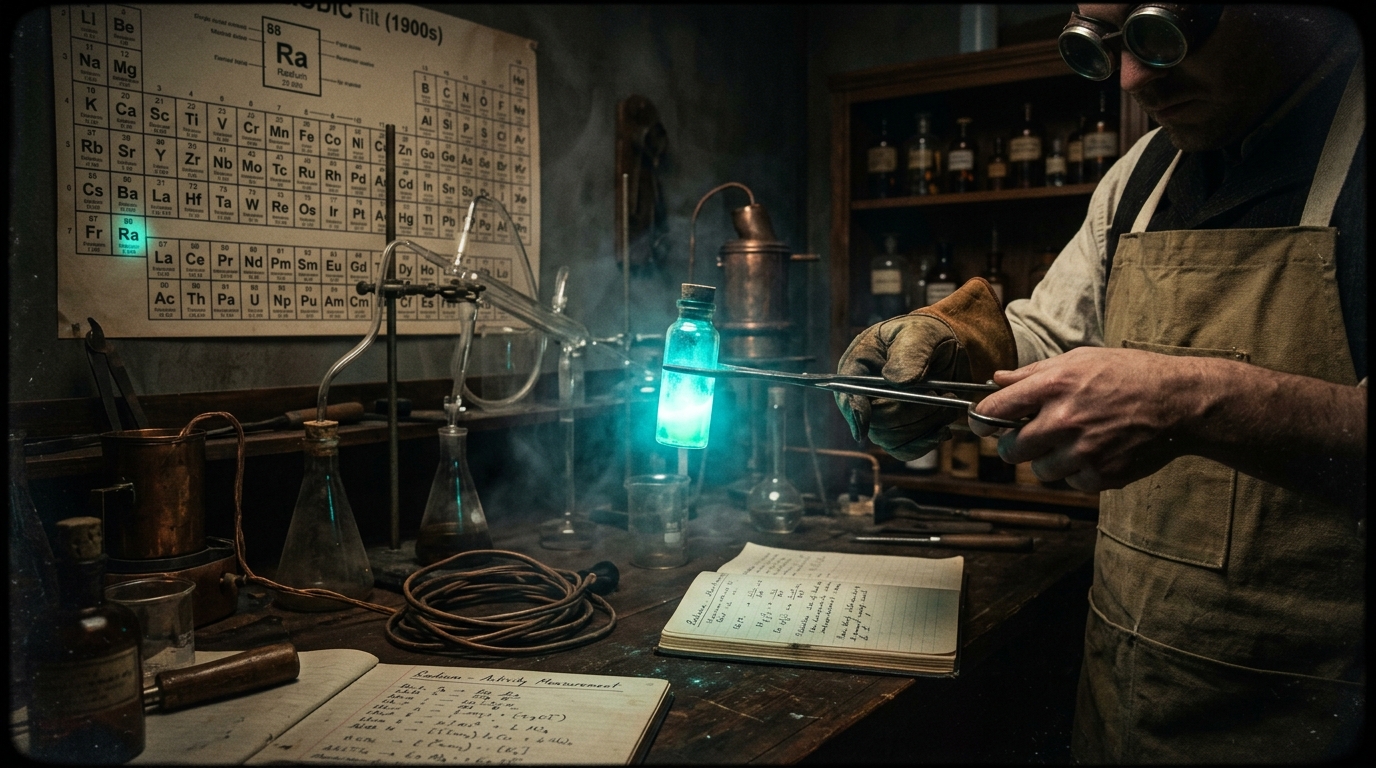
Marie Curie changed the scientific world forever when she discovered Rádiem in 1898 alongside her husband Pierre. This brilliant, glowing element opened a brand-new doorway into the mysterious realm of nuclear physics. Scientists suddenly realized that atoms were not solid, unchangeable spheres.
Instead, certain heavy elements could naturally decay and release massive amounts of energy over time. This specific discovery sparked an era of intense fascination, tragic mistakes, and groundbreaking medical advancements. Today, we understand this element as both a historical marvel and a cautionary tale about radioactive materials.
The Historic Discovery of a New Element
Marie and Pierre Curie spent years working in a drafty, poorly insulated shed in Paris to isolate this substance. They noticed that an ore called pitchblende emitted far more radiation than pure uranium. Consequently, they suspected that an undiscovered, highly active element hid inside the dark mineral matrix.
They refined tons of industrial waste material through a tedious process of repeated crystallization. Eventually, they successfully isolated a tiny fraction of a gram of a new, intensely radioactive chloride salt. They named it after the Latin word for ray because it emitted beautiful, eerie blue light.
Refining the Extraction Process
Extracting the pure element required immense physical labor and incredible patience. The Curies stirred giant vats of boiling chemicals with heavy iron rods for hours. They faced constant exposure to toxic fumes and invisible, hazardous radiation fields without any modern protective gear.
Furthermore, they lacked the financial resources that established industrial laboratories enjoyed during that golden age of chemistry. They persevered because their intense passion for scientific discovery outweighed every physical hardship. In 1902, they finally prepared enough pure material to determine its official atomic weight.
Chemical and Physical Properties
This element belongs to the alkaline earth metal group on the periodic table. Therefore, it shares many chemical characteristics with barium, calcium, and magnesium. In its pure metallic form, it exhibits a brilliant silver color that quickly turns black upon exposure to air.
It reacts vigorously with water to form a hydroxide compound and volatile hydrogen gas. The element possesses an atomic number of 88 and a highly unstable nucleus. This instability causes it to decay continuously into a series of other elements.
       [Radium-226]
            │
            ▼ (Emits Alpha Particle)
       [Radon-222]
            │
            ▼
       [Polonium-218]
Understanding the Luminescence
Many people believe that pure radioactive isotopes glow brightly on their own through simple phosphorescence. However, the famous blue-green glow actually results from the excitation of surrounding air molecules. The intense alpha particles strike nitrogen atoms in the atmosphere, which then release visible light.
Furthermore, early manufacturers mixed the substance with zinc sulfide to create self-luminous paint for consumer goods. This clever mixture allowed watch dials, compasses, and airplane instruments to shine brightly in total darkness. Unfortunately, this commercial application led to one of the worst public health disasters in industrial history.
The Commercial Craze and the Radium Girls
During the early twentieth century, a massive commercial craze swept through the United States and Europe. Corporations marketed the glowing element as a miraculous health tonic, a source of endless energy, and a luxury ingredient.
People eagerly bought radioactive water, glowing cosmetics, toothpaste, and even radioactive blankets for their homes. Doctors routinely prescribed these dangerous elixirs for arthritis, blindness, and chronic fatigue. The public believed that radioactivity stimulated cellular life and reversed the natural aging process.
┌────────────────────────────────────────────────────────┐
│             Early 20th Century Products                │
├──────────────────────────┬─────────────────────────────┤
│ Radithor Water           │ Energy tonic drink          │
│ Radior Cosmetics         │ Glowing facial creams       │
│ Undark Paint             │ Luminous watch dials        │
└──────────────────────────┴─────────────────────────────┘
The Tragedy of the Watch Dial Painters
Young factory workers, later known as the Radium Girls, painted watch dials with luminous paint in New Jersey and Illinois. Factory managers explicitly told the women that the glowing substance was entirely harmless.
Therefore, the workers pointed their paintbrushes with their lips to maintain a sharp, precise tip. Each time they did this, they swallowed a small amount of the deadly element.
“The workers pointed their paintbrushes with their lips to maintain a sharp, precise tip, swallowing deadly material.”
Consequently, the radioactive material accumulated directly in their bones, which caused horrific necrosis and fatal cancers. The brave women eventually sued their employers, which established crucial workplace safety laws for future generations.
Medical Breakthroughs and Early Cancer Therapy
Despite its profound dangers, the element played a pioneering role in the birth of modern oncology. Doctors discovered that targeted radiation could shrink malignant tumors and kill fast-growing cancer cells.
This early form of treatment, called brachytherapy, involved placing tiny radioactive needles directly inside or near tumors. Scientists used these methods to treat cervical, prostate, and skin cancers with surprising success rates.
-
Targeted Destruction: High-energy rays break the DNA strands inside abnormal cells.
-
Healthy Tissue Sparing: Careful placement limits the radiation dose to surrounding organs.
-
Historical Milestone: This technique laid the foundation for modern linear accelerators.
As technology advanced, safer isotopes like cobalt-60 and cesium-137 eventually replaced the original element in hospitals. These modern alternatives provided more predictable radiation beams and posed fewer long-term environmental hazards. However, the original research proved that radiation was a powerful weapon against terminal disease.
Environmental Legacy and Modern Safety Challenges
The historical production of luminous products left behind a legacy of severe environmental contamination. Many old factory sites, laboratories, and landfills remain dangerously radioactive today.
Governments must spend millions of dollars to locate, excavate, and safely store these toxic relics. The element possesses a half-life of 1,600 years, so it will remain hazardous for millennia.
Managing Radon Gas Accumulation
When this element decays, it transforms into radon, a heavy, colorless, and completely odorless radioactive gas. Radon can easily seep through cracks in basement floors and accumulate inside residential buildings.
Inhaling this gas stands as the second leading cause of lung cancer worldwide today. Therefore, modern environmental agencies recommend routine testing for radon in areas with uranium-rich soil. Proper ventilation systems can easily mitigate this hidden hazard and protect public health.
The Element in Modern Scientific Research
Today, industrial use of this material has declined significantly, but it remains valuable in specialized research fields. Geologists use the decay chains of radioactive isotopes to determine the precise age of rocks and marine sediments.
By measuring isotope ratios, scientists can track the historical movement of deep ocean currents over centuries. This data helps researchers build more accurate models of global climate change.
Furthermore, nuclear physicists use the element to synthesize heavier, superheavy elements in advanced particle accelerators. Bombarding target elements with heavy ions allows scientists to explore the absolute limits of atomic stability. Therefore, Marie Curie’s discovery continues to expand our fundamental understanding of the physical universe.