
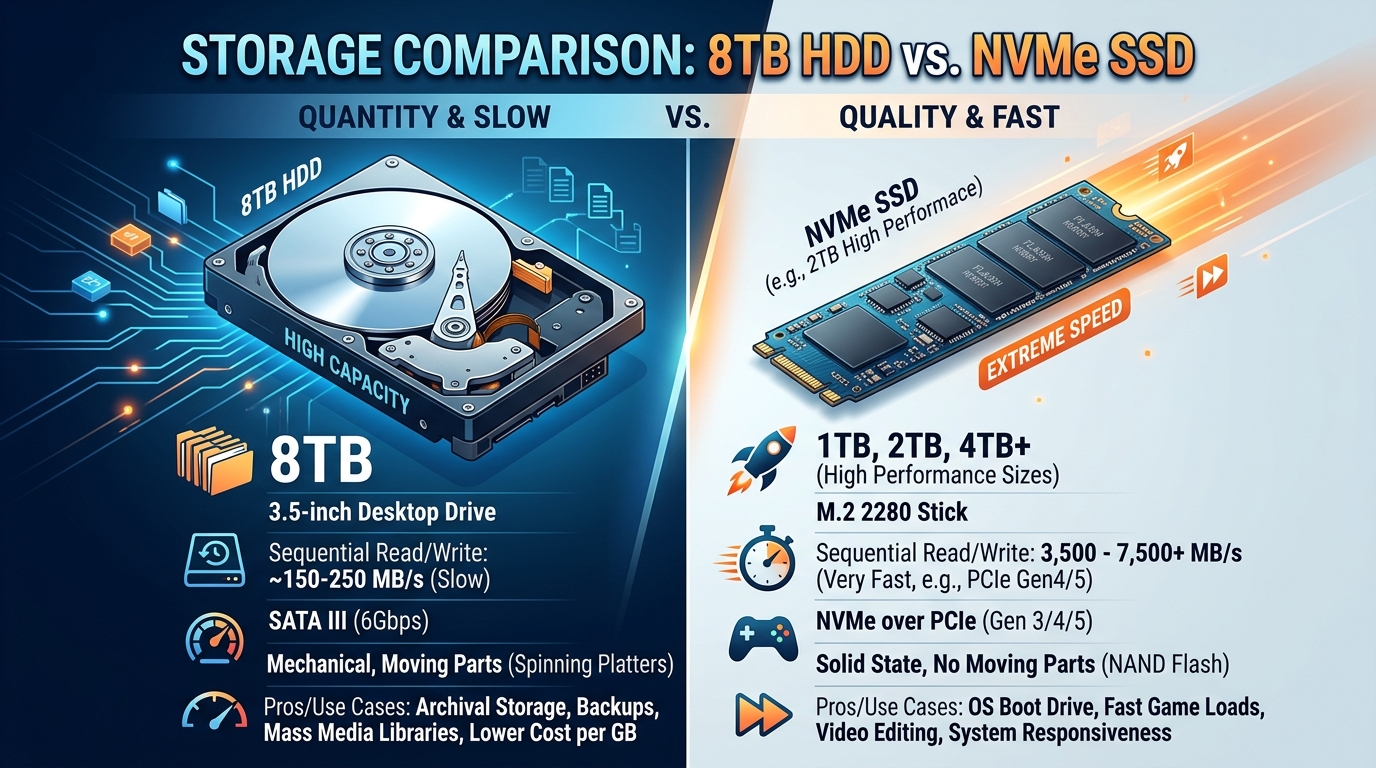
Choosing between 8TB HDD vs. NVMe storage remains one of the most important decisions facing infrastructure planners today. Both options offer distinct advantages depending on workload requirements, budget constraints, and long-term scalability goals. Consequently, understanding the fundamental differences between these technologies helps administrators make informed, cost-effective purchasing decisions. Server performance, reliability, and total cost of ownership all hinge significantly on this critical storage choice. This article explores both technologies thoroughly to help you determine the ideal fit.
Understanding Traditional 8TB HDD Technology
Hard disk drives rely on spinning magnetic platters and mechanical read-write heads to store data. This mature technology has powered data centers for decades, offering reliable performance at accessible price points. Additionally, 8TB HDD units provide substantial storage capacity, making them ideal for archival and backup purposes. Manufacturers have refined mechanical components over many years, improving durability despite the technology’s inherent physical limitations. However, moving parts introduce latency and potential failure points absent in solid-state alternatives. Understanding these mechanical fundamentals helps administrators appreciate both the strengths and constraints of HDD storage.
Exploring NVMe Technology and Its Advantages
NVMe, or Non-Volatile Memory Express, represents a modern protocol designed specifically for solid-state storage devices. Unlike traditional drives, NVMe communicates directly through the PCIe bus, eliminating bottlenecks found in older interfaces. Consequently, this architecture delivers dramatically faster read and write speeds compared to conventional storage solutions. Additionally, NVMe drives contain no moving mechanical parts, reducing failure risks associated with physical wear over time. Data centers increasingly adopt NVMe for performance-critical applications requiring minimal latency and maximum throughput. This technological shift reflects broader industry trends toward faster, more efficient storage infrastructure.
Comparing Raw Performance Between 8TB HDD and NVMe
Performance differences between 8TB HDD vs. NVMe storage become immediately apparent under real-world testing conditions. Traditional hard drives typically achieve sequential read speeds around 250 megabytes per second under optimal conditions. Meanwhile, NVMe drives routinely exceed 3,000 megabytes per second, representing performance gains exceeding tenfold improvements. Furthermore, random access performance shows even starker contrasts, with NVMe drastically outperforming mechanical alternatives consistently. This speed advantage becomes especially noticeable during database operations, virtualization tasks, and high-transaction application environments. Consequently, workloads demanding rapid data access benefit enormously from NVMe’s superior architectural design.
Cost Considerations for Server Storage Solutions
Budget remains a critical factor when evaluating 8TB HDD vs. NVMe options for server deployment. Traditional hard drives offer significantly lower cost per gigabyte, making them attractive for bulk storage needs. Additionally, organizations requiring massive capacity for archival purposes often prioritize HDD solutions for financial reasons. However, NVMe pricing has decreased substantially in recent years, narrowing the gap between these technologies. Furthermore, total cost of ownership calculations should include factors beyond initial purchase price alone. Energy consumption, cooling requirements, and potential downtime costs all influence long-term budgetary considerations significantly.
Reliability and Longevity in Data Center Environments
Reliability concerns influence storage decisions heavily, particularly within mission-critical data center environments requiring constant uptime. Mechanical hard drives face wear from spinning components, potentially leading to failures after extended usage periods. Conversely, NVMe drives avoid mechanical wear entirely, though they experience different degradation patterns through write cycles. Additionally, environmental factors like temperature and humidity affect both technologies differently across various deployment scenarios. Manufacturers now provide detailed endurance ratings, helping administrators predict expected lifespan under specific workload conditions. Therefore, understanding these reliability metrics becomes essential when planning long-term infrastructure investments and maintenance schedules.
Power Consumption and Energy Efficiency Differences
Energy efficiency represents another important consideration when comparing 8TB HDD vs. NVMe storage solutions. Traditional hard drives consume more power during operation due to mechanical spinning and seeking. Meanwhile, NVMe drives typically require less energy, benefiting from their solid-state, non-mechanical design architecture. Consequently, large-scale data centers can achieve meaningful cost savings by transitioning toward more efficient NVMe storage. Additionally, reduced power consumption often correlates with lower cooling requirements, further decreasing overall operational expenses. These efficiency gains become particularly significant when scaling storage across hundreds or thousands of server units.
Ideal Use Cases for 8TB HDD Storage
Certain applications continue benefiting significantly from traditional 8TB HDD storage despite newer technological alternatives available. Backup and archival systems, where speed matters less than raw capacity, suit HDD deployment well. Additionally, organizations storing infrequently accessed data find HDD’s lower cost per gigabyte financially advantageous. Media storage, surveillance footage, and long-term compliance archives often rely heavily on mechanical drive technology. Furthermore, cold storage tiers within hybrid infrastructure setups frequently incorporate HDD solutions for cost efficiency. These use cases demonstrate that mechanical storage remains relevant within carefully planned, tiered infrastructure strategies.
Ideal Use Cases for NVMe Storage
Performance-sensitive applications gain substantial benefits from NVMe storage’s exceptional speed and low latency characteristics. Database servers handling high transaction volumes require rapid data access that mechanical drives cannot provide. Additionally, virtualization environments running multiple simultaneous workloads benefit from NVMe’s superior input-output operations per second. Real-time analytics platforms processing large datasets rely on NVMe to minimize processing delays significantly. Furthermore, applications requiring instant scalability, such as content delivery networks, favor NVMe’s rapid response capabilities. These scenarios illustrate why performance-critical infrastructure increasingly prioritizes NVMe over traditional mechanical alternatives.
Hybrid Storage Strategies Combining Both Technologies
Many organizations adopt hybrid approaches, strategically combining 8TB HDD vs. NVMe storage within unified infrastructure designs. This tiered strategy places frequently accessed data on fast NVMe drives for optimal performance. Meanwhile, less critical or rarely accessed data remains stored on cost-effective HDD systems. Consequently, this balanced approach maximizes performance where needed while controlling overall infrastructure costs effectively. Additionally, automated tiering software can dynamically move data between storage types based on access patterns. This intelligent hybrid strategy allows organizations to optimize both performance and budget simultaneously across diverse workloads.
Scalability Considerations for Growing Infrastructure Needs
Scalability planning requires careful evaluation of both 8TB HDD vs. NVMe options as organizations grow. Hard drives offer straightforward capacity scaling, allowing administrators to add storage relatively affordably over time. However, NVMe scaling often involves higher upfront costs despite offering superior performance per storage unit. Additionally, physical space constraints within server racks may favor NVMe’s typically smaller form factor advantages. Furthermore, future workload predictions should influence scalability decisions, anticipating both capacity and performance requirements. Organizations must balance immediate budget constraints against long-term infrastructure flexibility when planning storage expansion strategies.
Compatibility and Infrastructure Requirements
Implementing NVMe storage often requires compatible motherboards, controllers, and infrastructure capable of supporting PCIe connections properly. Older server infrastructure may need upgrades before fully leveraging NVMe’s performance advantages effectively. Conversely, traditional HDD storage integrates seamlessly with most existing infrastructure through standard SATA or SAS connections. Additionally, organizations should evaluate current infrastructure compatibility before committing to significant storage technology transitions. Furthermore, mixed environments combining both storage types require careful planning regarding controllers, drivers, and management software compatibility. These infrastructure considerations significantly influence implementation timelines and associated costs during storage technology transitions.
Making the Right Choice for Your Organization
Ultimately, choosing between 8TB HDD vs. NVMe storage depends entirely on specific organizational needs and priorities. Organizations prioritizing raw capacity at minimal cost should lean toward traditional hard drive solutions. Conversely, performance-critical applications demanding speed and low latency benefit significantly from NVMe technology investment. Additionally, most modern data centers find hybrid approaches offer the most practical, balanced solution overall. Carefully assessing workload requirements, budget constraints, and future growth projections guides this important decision-making process. Therefore, thorough evaluation ensures organizations select storage infrastructure aligned with both current needs and future goals.
Conclusion: Balancing Performance and Practicality
The debate between 8TB HDD vs. NVMe storage ultimately reflects broader tradeoffs between performance and affordability. Neither technology universally outperforms the other across every possible use case and organizational requirement. Instead, understanding specific workload demands helps administrators select appropriate storage solutions for their unique infrastructure needs. Whether prioritizing raw capacity, blazing speed, or balanced hybrid approaches, informed decisions drive better outcomes. As data demands continue growing, thoughtful storage planning remains essential for maintaining efficient, reliable server infrastructure.