
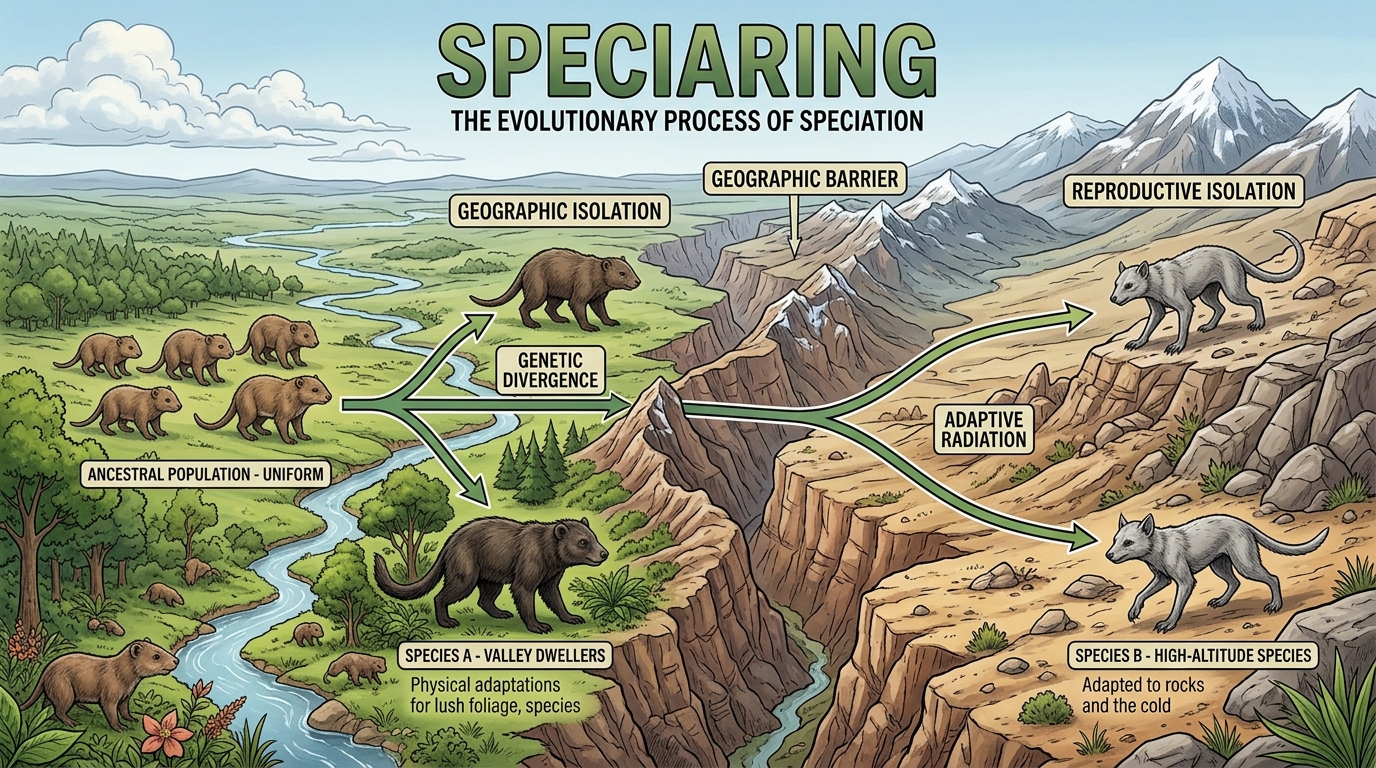
Speciering, more commonly known as speciation, describes the evolutionary process through which new species emerge from a shared ancestral population. This concept sits at the very heart of evolutionary biology, explaining why Earth hosts such staggering biological diversity. Consequently, understanding speciering means understanding how life itself branches, adapts, and diversifies across generations. This article explores how the process actually works, the mechanisms driving it, and why it matters more than ever in today’s rapidly changing world.
What Speciering Actually Means
At its core, speciering refers to the gradual formation of genetically distinct, reproductively isolated lineages from an original ancestral population. Two populations qualify as separate species once they can no longer interbreed successfully, even if they share a common origin. Therefore, the defining feature of this process is not physical appearance but genetic and reproductive separation over time.
Scientists typically categorize reproductive isolation into two broad types: prezygotic and postzygotic barriers. Prezygotic barriers prevent mating or fertilization from occurring in the first place, often through behavioral differences or mismatched breeding timing. Postzygotic barriers, meanwhile, allow mating to occur but result in offspring that cannot survive or reproduce successfully. Both barrier types ultimately push populations further apart genetically, cementing their status as distinct species.
Why New Species Form at All
Populations rarely remain perfectly uniform across their entire range, and this natural variation sets the stage for speciering. Environmental pressures, geographic separation, and genetic mutations all introduce differences between subgroups within a single species. Over enough generations, these accumulated differences can become significant enough to prevent successful interbreeding.
Additionally, natural selection plays a powerful role in accelerating this divergence. When separated populations face different environmental challenges, individuals with traits suited to their specific surroundings tend to survive and reproduce more successfully. As a result, each population gradually adapts to its unique environment, and these adaptations compound over many generations. Eventually, the genetic gap between populations grows too wide to bridge, and speciering becomes essentially irreversible.
Geographic Isolation and Allopatric Speciering
Among the various mechanisms driving new species formation, geographic isolation stands out as one of the most well-documented pathways. This process, known formally as allopatric speciation, occurs when a physical barrier splits a single population into two separate groups. Mountain ranges, rivers, oceans, or even human-made structures can all serve as effective barriers.
Once separated, each population experiences its own distinct evolutionary pressures, since environmental conditions rarely stay identical on both sides of a barrier. Consequently, genetic mutations accumulate independently within each group, and natural selection favors different traits depending on local conditions. Over sufficient time, these isolated populations diverge enough that even if the physical barrier eventually disappears, the two groups can no longer interbreed successfully. Darwin’s finches in the Galápagos Islands offer a classic illustration of this exact mechanism, since geographic separation across different islands drove distinct adaptations in beak shape and feeding behavior.
Sympatric Speciering Without Physical Separation
While geographic isolation explains many cases of speciering, new species can also form without any physical barrier whatsoever. This alternative pathway, called sympatric speciation, occurs when populations diverge genetically while still occupying the same geographic space. Although less intuitive than allopatric speciation, this mechanism happens more frequently than early researchers once assumed.
Behavioral differences often drive sympatric speciering, particularly when subgroups develop distinct mating preferences or feeding habits within a shared habitat. The apple maggot fly provides a compelling contemporary example, since populations gradually shifted from feeding on native hawthorn fruit toward feeding on introduced apple trees. This dietary shift altered mating timing and location preferences, gradually creating reproductive isolation despite both groups occupying identical geographic territory. Over successive generations, these behavioral differences solidified into genuine reproductive barriers.
The Role of Genetic Mutations and Chromosomal Changes
Beyond gradual environmental adaptation, sudden genomic changes can also trigger speciering with remarkable speed. Polyploidy, a condition involving extra sets of chromosomes, represents one particularly dramatic mechanism for rapid species formation. This phenomenon appears especially common among plants, where chromosomal duplication can instantly create reproductive incompatibility with the original parent population.
Furthermore, smaller genetic mutations can accumulate steadily within isolated populations, gradually building reproductive barriers over extended timeframes. Unlike polyploidy’s near-instantaneous effect, these incremental mutations require many generations before reproductive isolation becomes complete. Nevertheless, both mechanisms ultimately achieve the same fundamental outcome: genetically distinct populations incapable of successful interbreeding with their ancestral group.
Behavioral and Ecological Drivers of Speciering
Animal behavior frequently plays a decisive role in driving speciering forward, particularly through changes in mating rituals or habitat preferences. When populations develop distinct courtship behaviors, individuals become increasingly likely to select mates exhibiting similar behavioral traits. Consequently, this behavioral sorting gradually restricts gene flow between diverging groups, even without any geographic separation.
African rift lake cichlids demonstrate this behavioral mechanism exceptionally well, since researchers have documented remarkable species diversity within these lakes despite minimal physical barriers. Differences in coloration, courtship displays, and habitat preferences have driven extensive speciering among cichlid populations. Additionally, ecological factors like resource competition can push populations toward specializing in different food sources or habitat niches, further reinforcing reproductive isolation over time.
How Scientists Study and Document Speciering
Modern researchers rely heavily on genomic sequencing technology to study speciering with unprecedented precision. By comparing genetic material across related populations, scientists can identify exactly which genes contribute to reproductive isolation. This genomic approach has revealed that speciering often involves specific “barrier loci,” regions of the genome where genetic differences accumulate fastest between diverging populations.
Interestingly, genomic studies frequently show uneven patterns of differentiation across the genome during early speciering stages. Some genetic regions diverge rapidly while others remain nearly identical between populations, reflecting ongoing gene flow in certain areas despite growing isolation elsewhere. Meanwhile, later stages of speciering typically show more widespread genetic divergence across the entire genome. This detailed genomic perspective has transformed how researchers understand the gradual, uneven nature of species formation.
Speciering in the Context of Modern Environmental Change
Human activity increasingly influences the pace and direction of speciering across countless ecosystems worldwide. Habitat fragmentation, introduced species, and shifting climate patterns all create new evolutionary pressures that populations must navigate. Consequently, understanding speciering has become essential for predicting how biodiversity might respond to ongoing environmental disruption.
In some cases, human-altered environments have actually accelerated speciering, as demonstrated by the apple maggot fly’s rapid adaptation to introduced apple trees. However, human activity can also disrupt natural speciering processes by eliminating the geographic barriers or ecological niches that once drove divergence. Therefore, conservation biologists increasingly consider speciering dynamics when developing strategies to protect genetic diversity and ecosystem resilience. This intersection between evolutionary biology and conservation science highlights why speciering research extends far beyond purely academic curiosity.
Common Misconceptions About Speciering
Despite widespread scientific consensus, several misconceptions about speciering persist among the general public. Many people assume species formation always requires enormous timescales spanning millions of years, but this assumption oversimplifies a genuinely variable process. While some speciering events do unfold gradually over extensive periods, mechanisms like polyploidy can produce reproductive isolation almost immediately.
Another common misunderstanding involves the assumption that physical appearance alone determines species boundaries. In reality, reproductive isolation, not visual distinctiveness, serves as the defining criterion for speciering. Two populations might look remarkably similar yet remain genetically and reproductively separate, while other populations might display significant physical variation despite belonging to the same interbreeding species. Recognizing these nuances helps clarify why speciering research requires careful genetic and behavioral analysis rather than simple visual classification.
Why Speciering Remains Central to Evolutionary Biology
Ultimately, speciering explains one of biology’s most fundamental questions: how did Earth’s extraordinary diversity of life actually originate? Every species alive today traces its existence back through countless speciering events, each one adding another branch to life’s evolutionary tree. Without this ongoing process, biodiversity as we know it simply could not exist.
Moreover, studying speciering offers valuable insight into life’s remarkable adaptability under changing conditions. As global environments continue shifting due to climate change and human activity, understanding how new species form becomes increasingly relevant for predicting future biodiversity patterns. Therefore, speciering research extends its relevance well beyond theoretical evolutionary biology, informing conservation strategy, agricultural science, and our broader understanding of life’s resilience.
Conclusion
Speciering represents far more than an abstract evolutionary concept confined to textbooks and research papers. From Darwin’s finches adapting across isolated islands to apple maggot flies shifting their feeding habits within shared territory, this process continuously shapes the living world around us. Geographic isolation, behavioral divergence, and genetic mutations all contribute distinct pathways toward the same fundamental outcome: genetically distinct, reproductively isolated populations. As environmental change accelerates globally, understanding speciering becomes increasingly vital for predicting how life will continue adapting, diversifying, and persisting across an uncertain future.