
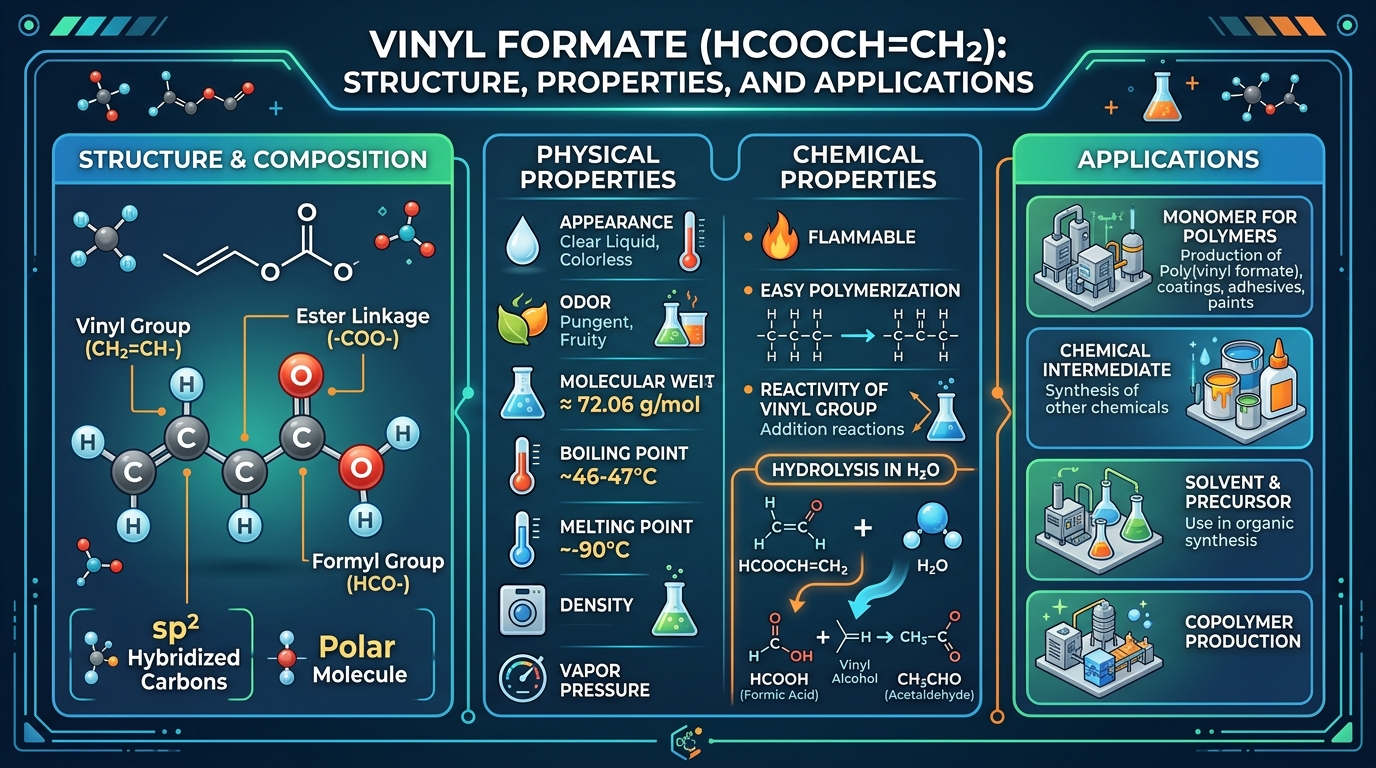
HCOOCH CH2 H2O represents vinyl formate, an ester formed from formic acid and vinyl alcohol’s reactive framework. Consequently, this compound belongs to a broader family of vinyl esters used across organic chemistry. When combined with water, vinyl formate undergoes hydrolysis, breaking down into simpler molecules. Therefore, understanding this reaction requires examining both the compound’s structure and its chemical behavior. This article explains the molecular structure, properties, and practical applications tied to this ester and its hydrolysis with water.
Understanding the Molecular Structure of Vinyl Formate
Vinyl formate consists of a formate group attached to a vinyl group through an oxygen bridge. Specifically, the formula HCOOCH=CH2 shows a formyl carbon bonded to oxygen, which then connects to vinyl carbon. Additionally, the vinyl portion contains a carbon-carbon double bond, giving the molecule notable reactivity. This double bond distinguishes vinyl esters from simpler saturated esters like methyl formate. Furthermore, the ester linkage itself remains susceptible to hydrolysis under acidic or basic conditions. Because of this dual reactivity, both the ester bond and the vinyl group matter chemically. Consequently, chemists study this compound to understand ester behavior alongside vinyl group reactions.
The Ester Functional Group Explained
Esters form when a carboxylic acid reacts with an alcohol, releasing water as a byproduct. In this case, formic acid, the simplest carboxylic acid, provides the acyl portion of the molecule. Meanwhile, the vinyl alcohol component, though unstable on its own, contributes the alkyl-like portion. Therefore, vinyl formate technically results from combining formic acid with vinyl alcohol conceptually. However, vinyl alcohol rapidly converts into acetaldehyde through tautomerization under normal conditions. This instability makes vinyl esters synthetically important precursors rather than simple alcohol derivatives. Consequently, industrial production often relies on alternative synthetic routes rather than direct esterification methods.
How Vinyl Formate Reacts With Water
When vinyl formate meets water, hydrolysis breaks the ester bond into two separate products. Specifically, the reaction cleaves the bond between the formate group and the vinyl oxygen. As a result, this process generates formic acid as the first hydrolysis product. Meanwhile, the vinyl alcohol fragment immediately tautomerizes into acetaldehyde due to its inherent instability. Therefore, the overall reaction produces formic acid and acetaldehyde as final, stable products. This tautomerization step happens almost instantaneously because vinyl alcohol cannot exist in significant quantities. Consequently, chemists rarely observe vinyl alcohol directly during this hydrolysis reaction in practice.
The Chemical Mechanism Behind Hydrolysis
Ester hydrolysis typically follows one of two mechanisms, depending on whether acid or base catalyzes the reaction. Under acidic conditions, a proton first attaches to the ester’s carbonyl oxygen, increasing electrophilicity. Subsequently, a water molecule attacks the now more electrophilic carbonyl carbon, forming a tetrahedral intermediate. This intermediate then collapses, releasing the vinyl alcohol portion and regenerating formic acid. Alternatively, under basic conditions, hydroxide ions attack the carbonyl carbon directly without prior protonation. Therefore, base-catalyzed hydrolysis proceeds through a slightly different pathway toward similar final products. Either way, the vinyl alcohol intermediate quickly tautomerizes into acetaldehyde once it forms. Consequently, both mechanisms ultimately converge on the same stable end products.
Factors That Influence the Hydrolysis Rate
Several factors determine how quickly vinyl formate hydrolyzes when exposed to water. First, temperature significantly affects reaction speed, since higher temperatures increase molecular collision frequency. Second, the presence of acid or base catalysts accelerates the reaction considerably compared to neutral water. Third, concentration levels of both the ester and water influence overall reaction kinetics. Additionally, the reaction remains reversible under certain conditions, meaning products can potentially reform the ester. Therefore, chemists often remove products or use excess water to drive hydrolysis forward. Furthermore, solvent choice can also impact reaction rates by affecting molecular interactions and stability. Consequently, controlling these variables allows for predictable and efficient hydrolysis in laboratory settings.
Physical and Chemical Properties of Vinyl Formate
Vinyl formate exists as a colorless liquid with a characteristic ester-like odor at room temperature. Additionally, this compound demonstrates moderate volatility, evaporating relatively quickly when exposed to open air. Because of its unsaturated vinyl group, the molecule readily participates in polymerization reactions under appropriate conditions. Furthermore, the ester bond remains sensitive to moisture, making proper storage conditions genuinely important. Vinyl formate also exhibits flammability, requiring careful handling procedures during storage and laboratory use. Meanwhile, its reactivity toward both nucleophiles and radicals makes it versatile in synthetic chemistry applications. Therefore, understanding these properties helps chemists handle and utilize the compound safely and effectively.
The Role of the Vinyl Group in Reactivity
The vinyl group’s carbon-carbon double bond significantly influences how this molecule behaves chemically. Unlike saturated esters, vinyl formate can undergo addition reactions across this reactive double bond. For example, radical polymerization can convert vinyl formate monomers into larger polymer chains. Additionally, this double bond allows the compound to participate in various organic synthesis pathways. Consequently, vinyl esters serve as valuable building blocks for creating more complex molecular structures. Furthermore, the electron-rich nature of the double bond makes it susceptible to electrophilic attack. Therefore, chemists exploit this reactivity when designing synthesis routes for specialized polymer applications.
Applications in Polymer Chemistry
Vinyl esters, including vinyl formate, play a meaningful role in polymer synthesis processes. Because the vinyl group readily polymerizes, these compounds serve as monomers for creating various plastics. Additionally, copolymerization with other vinyl monomers produces materials with tailored physical properties. For instance, combining vinyl esters with different monomers can adjust flexibility, strength, and durability characteristics. Therefore, polymer chemists value vinyl formate as a building block for specialized material development. Moreover, these polymerization reactions typically require initiators that generate free radicals to begin the process. Consequently, controlling initiator concentration and reaction conditions determines the final polymer’s molecular weight and properties.
Industrial Relevance of Formate Esters
Formate esters, broadly speaking, find applications across several industrial sectors due to their reactivity. Specifically, formic acid derivatives often serve as intermediates in organic synthesis processes. Additionally, some formate esters function as solvents or reagents in chemical manufacturing operations. Because formic acid itself remains inexpensive and widely available, its ester derivatives offer economical synthetic options. Therefore, industries exploring cost-effective chemical intermediates often consider formate ester chemistry. Furthermore, the hydrolysis products, formic acid and acetaldehyde, both hold independent industrial value. Consequently, this reaction pathway connects to broader chemical manufacturing processes beyond the ester itself.
Formic Acid: A Key Hydrolysis Product
Formic acid, one product of vinyl formate hydrolysis, serves numerous practical purposes across industries. This simple carboxylic acid finds use in leather tanning, textile processing, and agricultural applications. Additionally, formic acid functions as a preservative and antibacterial agent in livestock feed production. Because it occurs naturally in ant venom and certain plants, formic acid has long fascinating chemists. Furthermore, industrial production methods now generate formic acid at scale for commercial purposes. Therefore, understanding hydrolysis reactions that produce formic acid connects to practical manufacturing considerations. Consequently, vinyl formate hydrolysis represents one pathway among several for accessing this versatile acid.
Acetaldehyde: The Second Hydrolysis Product
Acetaldehyde, the second product formed during vinyl formate hydrolysis, also carries significant industrial importance. This compound serves as a precursor for manufacturing acetic acid and various other chemical products. Additionally, acetaldehyde plays a role in producing certain resins, dyes, and synthetic rubber materials. Because it forms through natural metabolic processes as well, acetaldehyde appears in various biological contexts. Furthermore, its reactivity makes it valuable for further synthetic transformations in organic chemistry. Therefore, the hydrolysis of vinyl formate indirectly connects to acetaldehyde-dependent industrial processes. Consequently, this reaction demonstrates how simple hydrolysis can yield commercially relevant chemical building blocks.
Safety Considerations When Handling This Compound
Working with vinyl formate and its hydrolysis products requires careful attention to safety protocols. Because the compound is flammable, proper storage away from heat sources remains essential. Additionally, formic acid, one hydrolysis product, causes skin and eye irritation upon direct contact. Therefore, protective equipment, including gloves and eye protection, should accompany any laboratory handling procedures. Furthermore, acetaldehyde, the other product, presents inhalation hazards and requires adequate ventilation during use. Consequently, laboratories working with these compounds typically follow established chemical safety guidelines rigorously. Moreover, proper waste disposal procedures prevent environmental contamination from these reactive chemical byproducts. This careful approach ensures safe handling throughout research and industrial applications alike.
Laboratory Methods for Studying This Reaction
Chemists studying vinyl formate hydrolysis typically monitor the reaction using several analytical techniques. For example, gas chromatography helps identify and quantify the formic acid and acetaldehyde products. Additionally, spectroscopic methods, including infrared spectroscopy, track functional group changes throughout the reaction. Furthermore, pH monitoring provides insight into the reaction’s progress since formic acid affects solution acidity. Therefore, combining multiple analytical approaches gives researchers a comprehensive understanding of reaction kinetics. Moreover, controlled laboratory conditions allow chemists to isolate variables like temperature and catalyst concentration. Consequently, these methods collectively help researchers optimize hydrolysis conditions for specific synthetic goals.
Why This Reaction Matters in Organic Chemistry Education
This hydrolysis reaction serves as a valuable teaching example within organic chemistry curricula. Because it demonstrates both ester hydrolysis mechanisms and tautomerization concepts simultaneously, students gain broader understanding. Additionally, the reaction illustrates how unstable intermediates, like vinyl alcohol, transform into stable products quickly. Therefore, instructors often use this example to connect multiple organic chemistry concepts within one reaction. Furthermore, understanding this mechanism helps students grasp broader principles applicable to other ester systems. Consequently, this reaction provides genuine pedagogical value beyond its specific industrial applications. Many chemistry programs reference similar hydrolysis reactions when teaching fundamental organic transformation principles.
Conclusion
Vinyl formate, represented by the formula HCOOCH=CH2, demonstrates fascinating chemistry when combined with water. Throughout this discussion, we examined its structure, hydrolysis mechanism, properties, and practical applications. Moreover, understanding how this compound breaks down into formic acid and acetaldehyde reveals broader chemical principles. Whether studied for educational purposes or industrial applications, this reaction offers genuine scientific value. Therefore, examining both the ester bond and vinyl group reactivity provides comprehensive chemical insight. As organic chemistry continues advancing, foundational reactions like this remain relevant for research and industry. Ultimately, vinyl formate hydrolysis exemplifies how simple molecules can yield chemically significant transformations.